

 Esperanto
 Shqiptare
 Euskara
 Zulu
Zulu
 Latinus
 Cymraeg
 தமிழ்
தமிழ்
 Slovak
 Slovak
 Afrikaans
Products
Contact us
Edna Yang
Tel: +86-510-8525-9383
Cell: +86-151-5221-3005
Email: edna.yang@bolibio.com
Jiangsu Boli Bioproducts Co.,Ltd.
Add: 93 Yangzhou Road, Jiangyan Economic Development Zone, Jiangsu 225500, China
Jiangsu Boyang Bioproducts Co., Ltd.
Add: 30 Tongwang Road, Nantong Economic Development Zone, Jiangsu 226010, China

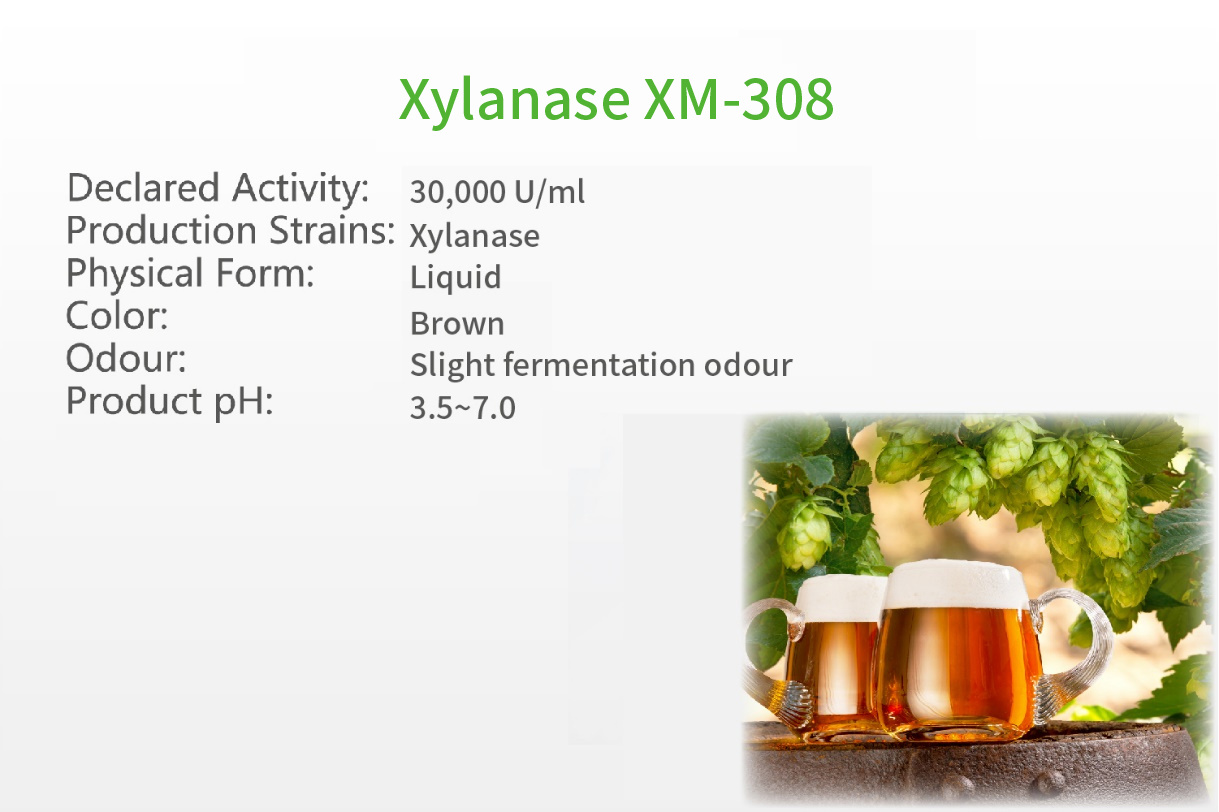
Xylanase XM-308
Category:
Product Description
Xylanase XM-308 is a high-efficient biological preparation made of excellent strains through submerged fermentation and downstream processes. In addition to xylanase, it also contains beta-glucanase, cellulase and alpha-amylase. This enzyme is specially designed for the alcohol fermentation and brewing from grains (such as wheat, rye, barley and triticale) in the production of oligosaccharides and deep processing of grains, where it can help to reduce starch viscosity and increase yield.
| Declared Enzyme: | Xylanase |
| Appearance: | Light brown liquid |
| Activity: | 30,000U/ml |
| pH: | 3.5∼7.0 |
Effect of Temperature
XM-308 can work at temperatures from 30 to 70℃,with its optimal temperature range from 45 to 65℃. See Figure 1.
XM-308 can work at pH from 3.0 to 5.5, with its optimal pH range from 3.5 to 5.0. See Figure 1.

Excellent viscosity reduction effect
Capable to handle a wide range of raw materials, incl. wheat, rye, barley, triticale, oats, corn, etc.
Break the cell structure of wheat and promote the release of starch, protein and other active ingredients
Improve the saccharification and increase the fermentable products, thus increase the yield of alcohol
Helps to reduce consumptions of energy and water, thus save operating costs
Improve production efficiency, increase alcohol yield
Add XM-308 together with heat-stable alpha-amylase while mixing the raw materials. Heat up to 60∼62℃ and keep for 1 hour. And then heat up to the required liquefaction temperature for liquefaction. The typical dosage rate of XM-308 is 0.01%∼0.04% w/w. The exact dosage rate depends on the kind of raw materials. It is recommended to run small trials according to the actual situation so as to determine the optimized dosage rate prior to the regular use.
- Typical packaging is 30kg food-grade plastic drums or 1125 IBC totes.
- Customized packaging is available upon request.
- Typical shelf life is twelve months if this product is stored in its original packaging, sealed and unopened, protected from direct sunlight at 0∼25℃.
- Keep at clean, cool and dry storage room. Adverse conditions such as humidity and higher temperature may lead to a higher dosage requirement.
Inhalation of enzyme dust and mists should be avoided. In case of contact with the skin or eyes, promptly rinse with water for at least 15 minutes. For detailed handling information, please refer to the Safety Data Sheet.
Beyond these established uses, the xylanase enzyme is a key driver in the burgeoning field of biorefineries and biofuel production. Within the process of converting lignocellulosic biomass—such as agricultural residues—into fermentable sugars for bioethanol, xylanase plays a critical role. It works synergistically with other cellulolytic enzymes to deconstruct the robust plant biomass completely. By efficiently liberating pentose sugars from hemicellulose, the xylanase enzyme helps maximize sugar yield, improving the overall economic viability and efficiency of second-generation biofuel production.
In conclusion, the multifaceted xylanase enzyme stands out as a versatile and valuable tool across multiple industries. Its advantages encompass enhancing environmental sustainability in pulp processing, improving efficiency in animal feed, refining quality in food production, and enabling advanced biofuel generation. The enzyme's specificity, efficacy, and natural origin position it as a significant component in the shift towards more efficient and eco-friendly biotechnological solutions, with its potential applications continuing to expand through ongoing research and development.
Previous
Previous
Online message
About Us
Products
Send Inquiry


